
Fleet Management - A Sector Ripe for Consolidation

By Gb Ladipo, Co-Founding Partner, Pura Advisory
Fleet management is often described as a single industry, whereas in reality, it is an umbrella term for a sector that encompasses a range of different subsectors as shown below:
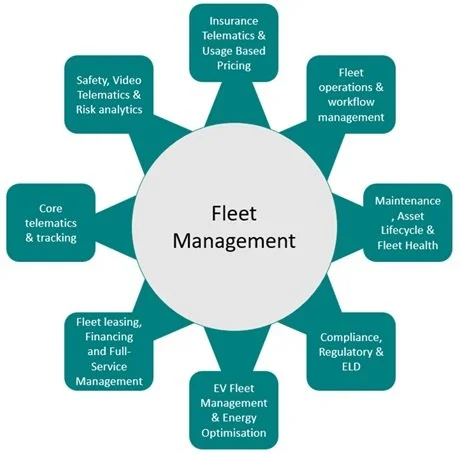
Unsurprisingly, sector dynamics, business models and valuations of businesses within each of these subsectors vary quite widely. However, they are united by one overarching theme: structural change is accelerating, and that change is driving consolidation. Three forces are reshaping the sector being, technology, customer behaviour and regulation – together they are fundamentally increasing the benefits of scaled operators.
Technology: driving the change from problem solvers to data interpreters
Fleet Management was historically a very manual, paper and people driven sector - for example vehicle tracking was completed via paper maps and route books, drivers typically checked in via landline when they reached their destination, fuel management was completed via paper receipts and KPIs were still largely tracked by spreadsheets, the problems were many and obvious.
Like many other industries, software has been a breakthrough meaning that guesswork and estimation have been replaced by data, delayed feedback moves to real time insight and reactive management has moved to proactive decision making / proactive control. In addition, AI has and will continue to supercharge innovation in this space.
However, this technological shift brings in a new dynamic – high fixed cost investment. Building, maintaining and consistently developing new technological tools require expertise and capital. Scaled operators are more likely to have the talent in-house and can spread these costs more easily therefore improving unit economics. Smaller operators will either need to invest heavily to remain competitive, partner with technology providers or become acquisition targets.
New customer behaviour: Increasing sophistication
Fleet customers are becoming more sophisticated and often require consolidated reporting, expect integrated telematics and insurance solutions and want to deal with a single counterparty. As such, procurement teams increasingly favour “one-stop-shop” providers capable of bundling a variety of services into a single contractual framework. Furthermore, the price for traditional services is being put under downward pressure by the technological developments within the industry, creating a margin squeeze that rewards scale and cross selling-ability.
Therefore, fleet management businesses that are able to provide breadth of service at a competitive cost will gain market share. Sub-scale specialists will have to either dominate a defensible niche or very quickly consider strategic alternatives.
Fragmentation: regulation raising the bar
In the UK, the wider sector remains highly fragmented with a range of operators offering a number of different services. Many businesses are regionally focused and have been able to survive because previously, capital requirements were modest, customer relationships were local, technology barriers were low and regulatory complexity was manageable.
That environment has changed markedly.
Alongside the technological and customer shifts described above, electrification, ESG reporting, compliance obligations and data governance requirements have raised the operational bar. At the same time, residual value risk has become more volatile, particularly as a result of the transition towards electric vehicles.
In our conversations with CEOs, it is clear that consolidation is top of mind. The question is not if consolidation is going to happen, it’s more a case of are they going to be a consolidator or are they getting ready to be consolidated?
For those on the acquisition path, the ability to acquire businesses to enable them to broaden product offerings and reach different areas of the market / become one-stop-shops for clients is becoming increasingly attractive. For those who may be acquired, the ability to service a particular niche of the market in a way that others cannot, tends to drive their relative attractiveness to acquirors.

So what happens next?
There are a number of fleet managers currently in market and we believe this will continue to be an active space in the short-to-medium term. Three developments are likely to define the next phase
1. Technology will continue to be a huge driver of change
When compared to other industries, Fleet management has been behind the curve in adopting technology. However, those companies that have been early adopters have seen strong top line growth and premium valuations being ascribed to them. As such, technology led vertical integration will be a key driver of M&A as businesses seek to enhance their own capabilities, with proprietary platforms becoming increasingly important differentiators.
2. Regulation will favour scale
Major regulatory and policy developments will affect how fleet managers operate with electrification, emissions reporting requirements and expanding compliance obligations placing an increased burden on businesses. Smaller players may struggle to keep pace without significant capital expenditure, larger operators are structurally better positioned to absorb and amortise these costs.
3. The range of buyers for fleet management businesses will continue to grow
The nature of buyers for fleet management businesses is continuing to widen as potential acquirors are attracted to an industry undergoing a technological shift whilst also being characterised by businesses with strong recurring contracted revenues, predictable replacement cycles, cross selling opportunities and strong data moats. Recent activity reflects this expanding buyer base, including:
· Flock being acquired by Admiral
· Jurni Leasing acquiring DriveElectric
· Total Motion being acquired by GKL Leasing
· TrakM8 being acquired by Omegro
· Global Vehicle Group acquiring Fleet Alliance
· LDC acquiring i247
Buyers now include trade consolidators, private equity platforms, international entrants, insurers and even fleet customers seeking vertical integration. Competition is likely to become increasingly fierce for the best assets
Conclusion
Fleet management is moving from being an operationally focused industry to one that is a technology-enabled, data-driven, compliance-heavy sector requiring capital, scale and strategic positioning. Consolidation is therefore more than an opportunity, it is a structural outcome
As the industry continues to undergo significant change, having completed over 100 successful transactions over a 20 year period, the Founding Partners at Pura Advisory, are particularly well placed to support founders navigate the M&A market